Straight-Line Wind Damage vs Tornado Damage: What Quad Cities Homeowners Should Know
Straight-Line Wind Damage vs Tornado Damage: What Quad Cities Homeowners Should Know
When storms tear through the Quad Cities, many homeowners immediately wonder whether the damage they see was caused by a tornado. In reality, most storm-related roof and siding damage in Illinois and Iowa comes from straight-line winds, not tornadoes.
Understanding the difference matters. Straight-line wind damage and tornado damage leave different signatures, affect homes differently, and can influence how damage progresses over time. For homeowners in Rock Island, Moline, Davenport, Bettendorf, and Milan, knowing what straight-line wind damage looks like helps explain why issues may appear even when no tornado was reported.
What Straight-Line Winds Actually Are
Straight-line winds are powerful winds that move in a single direction, often associated with thunderstorms, derechos, or downbursts.
How straight-line winds form
These winds typically develop when:
Thunderstorms collapse rapidly
Cold air rushes downward
Wind spreads outward at ground level
Unlike tornadoes, straight-line winds don’t rotate—but they can be just as destructive.
Why Straight-Line Winds Are So Common in the Midwest
The Midwest is especially prone to straight-line wind events.
Regional weather patterns
In the Quad Cities, storms often bring:
Strong cold fronts
Rapid pressure changes
Long storm lines spanning multiple counties
Repeated wind events in a single season
These conditions make straight-line winds far more frequent than tornadoes.
How Straight-Line Winds Damage Roofs
Straight-line winds apply sustained pressure, not brief rotational force.
Common roof impacts
Straight-line winds often cause:
Shingle seal strips to break
Shingles to lift and reseat
Fasteners to loosen
Ridge and hip shingles to shift
Because shingles may settle back into place, damage is often missed initially.
How Straight-Line Winds Affect Siding
Siding is especially vulnerable to sustained wind pressure.
Typical siding damage
Straight-line winds can:
Push behind siding panels
Flex panels repeatedly
Pull against fasteners
Open seams and trim gaps
Over time, this movement weakens siding’s ability to shed water.
Why Damage Isn’t Always Obvious Right Away
One of the biggest challenges with straight-line wind damage is delayed symptoms.
Why problems show up later
After wind events:
Shingles may look intact but lose adhesion
Siding may remain attached but loosen slightly
Moisture pathways open without immediate leaks
Weeks or months later, heavy rain reveals the damage.
How Tornado Damage Is Different
Tornado damage has distinct characteristics.
Tornado damage indicators
Tornadoes typically cause:
Rotational debris patterns
Severe, localized destruction
Uplift across multiple planes
Structural damage concentrated in narrow paths
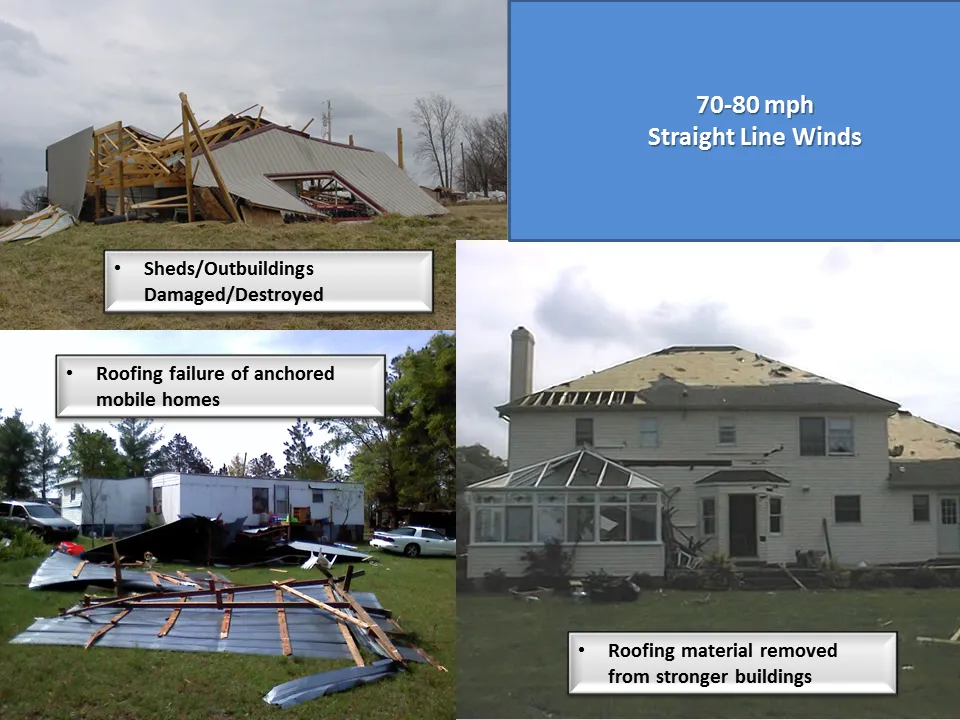
Straight-line wind damage, by contrast, is often widespread and directional.
Why Homes Can Be Damaged Without a Tornado Warning
Many homeowners assume no warning means no damage.
The reality of Midwest storms
Straight-line winds:
Don’t require tornado warnings
Can exceed 60–80 mph
Affect large geographic areas
Damage can occur even during storms that seem routine.
Roof Edges and Corners Take the Most Abuse
Wind pressure concentrates at specific roof areas.
High-risk roof zones
Straight-line winds most often damage:
Roof edges and eaves
Rakes and corners
Ridge caps
Valleys near edges
These areas are where uplift forces are strongest.
Interior Warning Signs After Wind Events
Straight-line wind damage often shows up inside the home first.
Interior clues to watch for
Ceiling stains after rain
Drafts near exterior walls
Whistling or rattling sounds during wind
Musty odors in attic spaces
These signs often point to wind-related roof or siding issues.
Why Straight-Line Wind Damage Escalates
What starts small can grow quickly.
Escalation pattern
Wind loosens materials
Adhesion and fastening weaken
Rain enters small openings
Moisture spreads behind surfaces
Interior damage appears
Catching damage early prevents this chain reaction.
Why Professional Inspections Matter After Windstorms
Straight-line wind damage isn’t always visible from the ground.
What professionals evaluate
Shingle adhesion and lift marks
Fastener movement
Siding panel flexibility
Flashing integrity
Roof edge behavior
This system-wide approach identifies damage others may miss.
Insurance and Straight-Line Wind Damage
Straight-line wind damage is typically covered when documented properly.
Why documentation matters
Establishes storm-related cause
Ties damage to a specific event
Helps differentiate from wear and tear
Early inspections support clearer decisions.
Why Local Experience Makes a Difference
Midwest wind damage follows predictable patterns. A local contractor understands:
Quad Cities wind behavior
Common straight-line wind failure points
How damage progresses after storms
That experience leads to more accurate evaluations.
When Homeowners Should Schedule an Inspection
An inspection is recommended:
After strong wind events
If shingles or siding look different
When neighbors report damage
Before seasonal weather changes
Earlier inspections limit long-term issues.
Schedule a Free Wind Damage Inspection
If your home has experienced strong winds—even without a tornado warning—a professional inspection can help identify hidden damage. Twin Bridge Roofing & Construction is a licensed and insured roofing & siding contractor serving the Quad Cities, offering free, no-obligation inspections to evaluate wind-related damage before it turns into leaks or moisture problems.
📞 Call or text 309-948-4126 to schedule your inspection
🌐 Visit roofqc.com to request an appointment online
